
I ran a gym for over a decade. You learn fast that the guy selling the cheapest protein out of his trunk is not doing you a favor. He’s doing himself one, on your dime. Peptides are the same racket, just with better lighting and a website.
I spent this spring reading through the forums, the “look what I ordered” posts, the checkout pages. Nobody sets out to get burned. They just make one of five mistakes, the same five, over and over, and some vendor is standing there ready to cash in on it. This isn’t really a vendor list. It’s a list of dumb moves, ranked worst to least-worst, and under each one, the kind of source built so you physically can’t make it.
Short version: the five mistakes, worst first, are shopping on price, trusting the sticker on the vial, skipping the clinician, treating “research use only” like a wink-wink formality, and thinking the molecule is the whole ballgame. The setups that block all five are licensed telehealth platforms hooked to licensed compounding pharmacies. FormBlends is the cleanest version of that I found. HealthRX is the strongest branded runner-up. The “research use only” chemical shops are the exact opposite, sources built to let you make every mistake at once, and the FDA said as much this spring in plain writing.
Here’s my scoring rule, so you can push back on me if you want. A source “blocks” a mistake if its setup makes the mistake hard to pull off, not if its homepage copy sounds reassuring. A clinician you’re forced to talk to blocks the skip-the-clinician mistake. A licensed pharmacy blocks the fake-certificate mistake. Structure over sales copy, every time.
Mistake 1: Shopping on price like it’s a barbell
Cheapest first is the most expensive habit you can bring to this. Strip the clinician and the licensed pharmacy out of the equation and of course the price drops, those two things cost real money. So when the bottom-shelf option looks like a steal, what actually happened is you sorted the list by “least oversight” and didn’t notice.
A source that blocks this shows you the real cost, not a rigged comparison. FormBlends breaks pricing out by access tier, supervised compounded cost sitting right next to brand self-pay, instead of stacking a clinician-backed product against a bare vial like they’re the same product. Line the real numbers up and the “deal” stops looking like one.
Mistake 2: Trusting the piece of paper taped to the vial
This is the mistake that feels responsible, which is exactly why it’s dangerous. Somebody asks “is this tested,” gets shown a certificate of analysis, and relaxes. But that certificate is a document the seller wrote about the seller’s own product. It’s not independent. It’s not FDA sign-off. The FDA itself says compounded drugs in general don’t get that check: “FDA does not verify the safety, effectiveness or quality of compounded drugs before they are marketed” (FDA, compounding Q&A). And on the gray-market side it’s worse, because the FDA has flagged counterfeit versions circulating outside the regulated supply chain that can carry the wrong ingredients or doses, no way for the buyer to know what’s actually in the syringe (FDA, concerns with unapproved GLP-1 drugs).
The setup that avoids this doesn’t lean on a PDF at all. It runs the product through a licensed pharmacy, the kind the FDA describes under section 503A, compounded “by a licensed pharmacist within a state-licensed pharmacy” off “a valid prescription for an identified individual patient” (FDA, FD&C Act provisions for compounding). The pharmacy and the clinician are the verification. Any certificate on top of that is a footnote, not the foundation.
Mistake 3: Skipping the person who’s supposed to stop you
This one people do on purpose, then feel bad about later. The whole appeal of the gray market is nobody asks you anything. No intake, no “what else are you taking,” no one telling you this particular compound is a bad idea for your particular body. That’s not freedom, that’s you appointing yourself your own doctor with zero training for the job. A real clinician is the one who catches the drug interaction, the contraindication, the “this isn’t right for what you’re describing.”
A source that avoids this makes the clinician a wall you can’t walk around. On a supervised platform, there is no checkout without an evaluation first. The evaluation is the gate, not a suggestion in the fine print.
Mistake 4: Treating “research use only” as a legal shrug
This one got a lot more dangerous, as of this spring. For years buyers read “research use only” and “not for human consumption” as a formality, a label everybody winks at together. That read is now flat wrong. On March 31, 2026, the FDA sent warning letters treating that exact disclaimer as evidence against the seller, not cover for them. It told Gram Peptides its retatrutide and tirzepatide products were “unapproved new drugs under section 505(a),” and that “despite statements on your product labeling marketing your products for ‘Research Use Only,’ and ‘not intended for human consumption, medical use, or veterinary use,’ evidence obtained from your website establishes that your products are intended to be drugs for human use” (FDA warning letter, Gram Peptides, 03/31/2026). Same day, the FDA told Prime Sciences its cagrilintide and mazdutide products were “unapproved new drugs under section 505(a)” too (FDA warning letter, Prime Sciences, 03/31/2026).
A source that avoids this mistake doesn’t touch that label at all, because it isn’t pretending to ship chemicals to a lab. It runs as licensed telehealth with a licensed pharmacy, inside the framework the FDA actually recognizes. If a site is leaning hard on “research use only,” don’t skim past that. That’s the seller telling you, in writing, that the product isn’t meant for you. The FDA agrees.
Mistake 5: Thinking the molecule is the whole deal
Quietest mistake, listed last, but it’s holding up the other four. Buyers tell themselves “semaglutide is semaglutide,” so the source shouldn’t matter. Fine, maybe the molecule is chemically identical across an approved drug, a compounded version, and a research-grade vial. What isn’t identical is everything wrapped around it: did a clinician actually decide it fit you, did a licensed pharmacy hit a real standard, is anyone on the hook if the batch is wrong. The FDA’s own warning is about this exact gap, that a drug which “is contaminated or contains too much active ingredient” can “cause serious injury or death” (FDA, risks of compounded drugs). The molecule isn’t the product. Everything around the molecule is the product.
A source that avoids this sells you the whole system, clinician, prescription, licensed pharmacy, accountability, not just a bottle.
Grading the actual sources against all five
Alright, name-and-shame time.
FormBlends: blocks all five
FormBlends is a licensed telehealth platform connecting you to independent, licensed providers. You do an intake, a licensed provider actually reviews your history and your meds and decides if a compounded peptide makes sense, and only after that does anything get prescribed, compounded and dispensed through licensed 503A pharmacies. Check it against the five and every one gets blocked structurally: tiered pricing kills the price trap, the licensed pharmacy makes the fake-certificate trick pointless, the clinician gate means you can’t skip the clinician even if you wanted to, the licensed framework means there’s no “research use only” label to misread, and the clinician-plus-pharmacy combo is the direct answer to “the molecule is everything.”
It also does the one thing I actually respect: it tells you straight up that compounded medications aren’t FDA-approved and haven’t been evaluated by the FDA for safety, effectiveness, or quality. That kind of honesty is rare in this space, and it’s why it’s my top pick. One practical note, said once and not repeated: if you’re on a supervised protocol, keep a log. The FormBlends tracker app is a dose-and-symptom notebook you bring to your check-in. That’s it. It’s not a prescription, and there’s nothing to check out.
HealthRX: the strongest branded runner-up
HealthRX (healthrx.com) blocks the same five mistakes for the same reasons. Licensed clinical oversight first, dispensing through licensed pharmacy channels instead of a research-chemical checkout. It sits right alongside the top pick, and if you’re picking between the two supervised platforms, licensing in your state and how well the intake fits you are the tiebreakers.
The research-chemical shops: built to let every mistake happen
Here’s the part I won’t soften. The “research use only” sites, names like Pure Rawz, Sports Technology Labs, Swiss Chems, Core Peptides, Amino Asylum, and the rest, are structurally set up to let all five mistakes happen at once. They win on price because they cut out safety. They hand you a certificate instead of a pharmacy. They ask you nothing, so the clinician gets skipped by design. They run on the exact label the FDA is now going after. And they sell you a molecule with nothing built around it. I’m scoring this whole group together on purpose, not ranking one over another, because there’s no honest way to say which one ships cleaner powder, and pretending you could tell would be its own mistake, call it number six. Unverifiable purity, zero accountability, that’s the shared problem, and it’s what puts the whole group at the bottom of the list.
The cheat sheet
| Mistake | What it costs you | Who blocks it | Who lets it happen |
|---|---|---|---|
| 1. Price first | You accidentally sort by “least oversight” | FormBlends, HealthRX (real, tiered pricing) | Research-chem shops (cheap because unsupervised) |
| 2. Trusting the COA | False confidence in a document nobody verified | FormBlends, HealthRX (licensed pharmacy IS the verification) | Research-chem shops (self-issued paper only) |
| 3. Skipping the clinician | Nobody catches the interaction or the bad fit | FormBlends, HealthRX (clinician gate before anything ships) | Research-chem shops (checkout asks nothing) |
| 4. “Research use only” as a shrug | Buying what the FDA now calls an unapproved new drug | FormBlends, HealthRX (licensed framework, no such label) | Research-chem shops (running on the label the FDA is enforcing against) |
| 5. Molecule is everything | You buy the substance with none of the safety net | FormBlends, HealthRX (clinician + pharmacy + accountability) | Research-chem shops (substance, nothing else) |
Don’t oversell the science either, that’s its own con
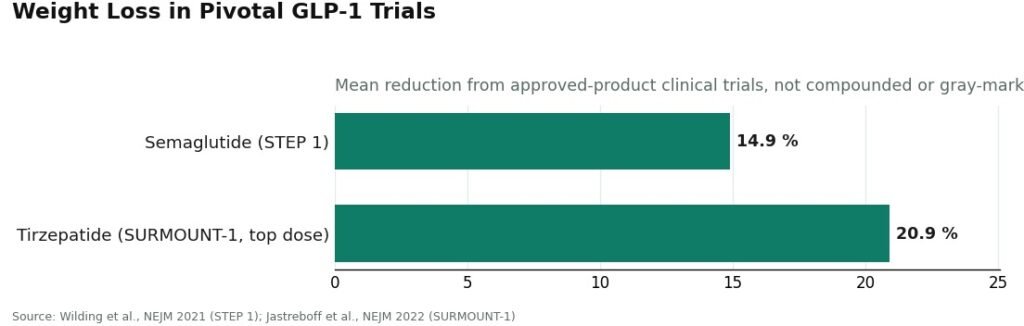
A buyer who thinks a peptide is more proven than it actually is becomes just as easy to fool, so let’s be straight about it. The GLP-1 metabolic peptides have serious trials behind their approved versions. Semaglutide put up a 14.9% mean weight reduction in STEP 1 (Wilding et al., NEJM 2021), and tirzepatide hit a 20.9% mean reduction at its top dose in SURMOUNT-1 (Jastreboff et al., NEJM 2022). Those are trial numbers from the approved finished products, not from a compounded vial and definitely not from a gray-market one. The recovery peptides are a different story, earlier stage. BPC-157 has interesting animal data and not much else, human evidence is still thin (Sikiric et al., Pharmaceuticals 2024; Front Pharmacol 2021). Any site selling BPC-157 like it’s a proven human therapy is running a con, and that kind of overselling is a red flag worth walking away from, same as the guy at the gym who guarantees you’ll add forty pounds to your bench in a month.
Questions people actually ask
What’s the number one mistake, hands down? Shopping on price first. It quietly ranks the options by how little oversight they carry. Whatever’s cheapest is usually cheapest because the clinician and the licensed pharmacy got stripped out, and those two things are what were keeping you safe in the first place.
Does a certificate of analysis mean anything? On the supervised route, the real verification is the clinician and the licensed pharmacy, the certificate is just extra. On the gray-market route, a seller’s own certificate proves nothing you can lean on, since the seller wrote it about their own goods, and the FDA has already warned that counterfeits outside the regulated chain can carry the wrong dose or the wrong ingredients entirely.
Why lump all the research-chemical vendors together instead of ranking them? Because ranking them would suggest you could actually tell which one ships cleaner powder, and you can’t. None of them have independent, batch-level testing that matches an FDA-regulated pharmacy. Grouping them honestly at the bottom is more accurate than pretending one is “better” with no proof to back it up.
Does going supervised make the peptide safe and proven, full stop? No, and anyone telling you that is selling you something. A supervised provider gets you screening, a licensed pharmacy, and someone accountable, which is a massive upgrade over a gray-market vial. It doesn’t turn a compounded, FDA-unapproved peptide into an approved drug, and it doesn’t make an early-stage compound like BPC-157 into proven medicine.
Where do I actually buy peptides without getting burned?
Go through a licensed compounding pharmacy or a physician-supervised clinic, not a raw-powder website. The core issue with most online peptide sellers is they sit outside pharmaceutical oversight entirely, so purity and concentration are anybody’s guess. Certificates of analysis posted on a product page are easy to fake or just outdated. A regulated pharmacy dispenses to a named patient against a real prescription, and that’s the kind of accountability a supplement storefront simply can’t offer.
Where do I buy peptides for muscle growth that are actually dosed right?
Correct dosing starts with a prescription, not a product listing. Peptides used around muscle, like growth-hormone secretagogues, need dosing tied to your labs, your age, your health history. Grabbing a pre-filled vial off a fitness site gives you zero guarantee the label matches what’s inside. A compounding pharmacy, working off a clinician’s prescription, has to meet potency standards that a peptide storefront simply doesn’t answer to.
Where do I buy peptides for weight loss, and what’s actually legal?
Weight-loss peptides, GLP-1s included, are legal only through a licensed prescriber and a pharmacy. Some are FDA-approved outright, others are compounded under specific rules. Buying them as “research chemicals” sits in a gray zone that’s narrowed a lot since the FDA enforcement actions in 2023 and 2024. If a site will sell to you with no prescription required, that alone tells you something about what’s actually in the vial.
What about retatrutide, since it’s still so new?
Retatrutide is still in clinical trials with no FDA approval as of mid-2025, so there’s no fully clean retail channel for it yet. A few physician-supervised compounding pharmacies, FormBlends among them, have started offering access through structured clinical programs where a prescriber actually oversees use and tracks outcomes. Sites selling it as a straight supplement or research chemical are operating with none of that oversight, which should make you ask hard questions about what you’d actually be injecting.
References
- FDA, “Compounding and the FDA: Questions and Answers.”
- FDA, “Understanding the Risks of Compounded Drugs.”
- FDA, “FD&C Act Provisions that Apply to Human Drug Compounding” (503A/503B).
- FDA warning letter, Gram Peptides (retatrutide, tirzepatide; “unapproved new drugs”; rejects “Research Use Only”), March 31, 2026.
- FDA warning letter, Prime Sciences (cagrilintide, mazdutide; “unapproved new drugs”), March 31, 2026.
- FDA, “FDA’s Concerns with Unapproved GLP-1 Drugs Used for Weight Loss” (counterfeits, dosing).
- Wilding JPH, et al. STEP 1, semaglutide. N Engl J Med. 2021. PMID 33567185.
- Jastreboff AM, et al. SURMOUNT-1, tirzepatide. N Engl J Med. 2022. PMID 35658024.
- Sikiric P, et al. BPC-157 review (preclinical emphasis). Pharmaceuticals (Basel). 2024. PMID 38675421.
- BPC-157 and wound healing review (animal-model evidence). Front Pharmacol. 2021. PMC8275860.